Jake Loudin
Kay ScarpettaJake Loudin is the Missouri businessman at the center of the novel’s pet-store cruelty thread, a figure whose public respectability collapses into the image of an industrial trafficker in vulnerable animals. His importance lies not only in the charges brought against him, but in the way his business appears to connect discarded puppies, concealed deaths, and the human violence associated with Mike Morales. Through Loudin, the novel makes the pet shop a threshold between ordinary commerce and organized brutality.
Public Identity and Reputation
Jake Loudin is identified by name when Shrew searches for the newspaper account of the man she has encountered at the pet store. The article describes him as a businessman from Missouri and reports that animal-protection activists call him the “puppy Pol Pot,” comparing him with the Khmer Rouge leader responsible for mass killings in Cambodia. The nickname is deliberately sensational, but it also records the scale and systematization that observers associate with Loudin’s treatment of animals.
His public image is further defined by the phrase “A CHARGE AGAINST PUPPY-MILL KING DROPPED,” the headline Shrew finds in the Times. The wording presents him as a “puppy-mill king,” not merely as an individual accused of mistreating a single animal. It places him within a commercial structure in which breeding, sale, failed transactions, and disposal are organized as part of one business system.
The Charges and the Legal Reversal
Loudin was charged in October after a raid on one of his pet stores in the Bronx. The case involved eight counts of aggravated cruelty to animals. The maximum possible sentence, had he been convicted on all eight offenses, was sixteen years in prison. A few weeks later, in December, the charges were dropped, producing a legal reversal that left the public accusation intact while removing the immediate criminal consequence.
The reason for the reversal was evidentiary. The eight dead animals found in the store’s freezer could not be shown to have been placed there alive. Jaime Berger, whose recently established animal-cruelty task force had participated in the October raid, explained that the judge believed the police had not adequately demonstrated the absence of justification for the animals’ euthanasia. The puppies were between three and six months old. Thus the case turns on a precise gap between moral horror and provable criminal conduct: the bodies were present, but the prosecution could not establish the crucial sequence that would convert suspicion into conviction.
The Pet-Store Network
Loudin’s business is connected to the lives of several other characters through the distribution and disposal of puppies. Dr. Elizabeth Stuart tells Kay Scarpetta that a man who works in her veterinary practice also has something to do with a pet store and has given puppies to members of her staff. He apparently helps care for animals there, though Dr. Stuart suspects that the care is not conducted in a manner she would approve. She recalls that he once offered her a sickly Chinese puppy as a birthday gift, an animal about one or two months old that trembled and coughed and appeared malformed. She returned it, and when asked what probably happened to the puppy afterward, she responds with ominous certainty.
The pet shop therefore functions as more than Loudin’s place of business. It is a system for converting living creatures into gifts, merchandise, failed inventory, or waste. Terri Bridges’s account of Ivy supplies the emotional counterpoint: the tiny dog, found nearly motionless in a basket, survives long enough to press its muzzle against Shrew’s neck and earns its name because it clings to her like ivy. Against that attachment stands the commercial logic suggested by Loudin’s store, where an animal that cannot be sold may be treated as disposable.
Connection to the Murders
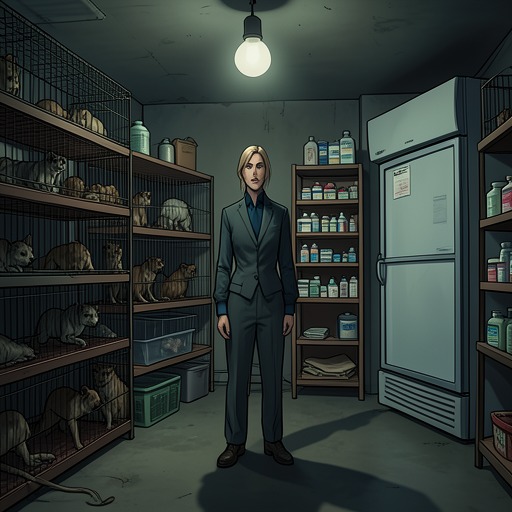
Shrew’s discovery in the store’s basement makes Loudin’s operation materially sinister. After drinking too much bourbon, she descends into a dim storage area that reeks of disease, feces, and urine. Cages filled with dirty paper stand among boxes of animal supplies and sacks of food. On a wooden table are glass tubes, injection needles, red bags marked “HAZARDOUS WASTE,” and heavy black rubber gloves. Beyond the table, an open freezer room contains a man in a dark suit and black cowboy hat and a woman in a long gray coat. Shrew sees what they are doing, freezes in terror, and is noticed when the woman turns and runs.
Later, the investigators have traced only Loudin in the pet-store strand. Berger suspects that Loudin may eventually admit knowing Mike Morales and may explain whether animals he could not sell were killed through Morales, or what other work Morales performed for him. She considers the possibility that Morales, operating under the name Juan Amate, went into pet-store basements for payment to add another portion of misery to the world. Berger does not think Loudin explicitly ordered Eva Peebles’s murder; instead, Eva became an unwanted witness after entering the basement at the wrong time, and Morales may have used that interference as an excuse for further violence.
Narrative Function
Loudin remains important even before the investigators secure a full confession or establish every link in the chain. His dropped charges illustrate how easily institutional proof can fail when violence is hidden inside a commercial process and when responsibility is distributed among owners, employees, veterinarians, and intermediaries. His store’s freezer, needles, cages, and hazardous-waste bags turn the language of pet retail into the material vocabulary of concealment.
The character also broadens the novel’s treatment of victimhood. The investigation begins amid public panic over the murders of people with dwarfism, while the pet-store evidence reveals a parallel economy in which puppies are bought, offered as gifts, returned, neglected, and possibly killed. Loudin’s significance is therefore structural: he helps connect animal commodification to human predation, and his apparent legal escape leaves the larger network still visible even when one prosecution has failed.